Pattern Matching vs Pattern Recognition

Intelligence · Cognition · AI
Memorization Is Not Intelligence
We have spent decades selecting for the wrong thing in our tests, our institutions, and now our machines. The distinction that matters isn't how much you know. It's whether you can refuse.
There is a cliché so embedded in our culture that almost no one questions it anymore: "He's brilliant but has no common sense." We say it admiringly. We've built a whole mythology around the absent-minded genius, too deep in abstraction to remember to eat, too lost in equations to navigate basic social reality. This framing doesn't just excuse dysfunction. It inverts reality.
The cliché protects a very specific cognitive profile: high verbal fluency, low deterministic rigor. People who can produce beautifully structured arguments, stack equations with elegance, and dominate any conversation about ideas, but who have quietly delegated actual logical grounding to a background heuristic process they don't examine too closely. We've been calling this genius. It isn't.
And now we've built AI systems in exactly the same image.
Two Regimes, Not One Spectrum
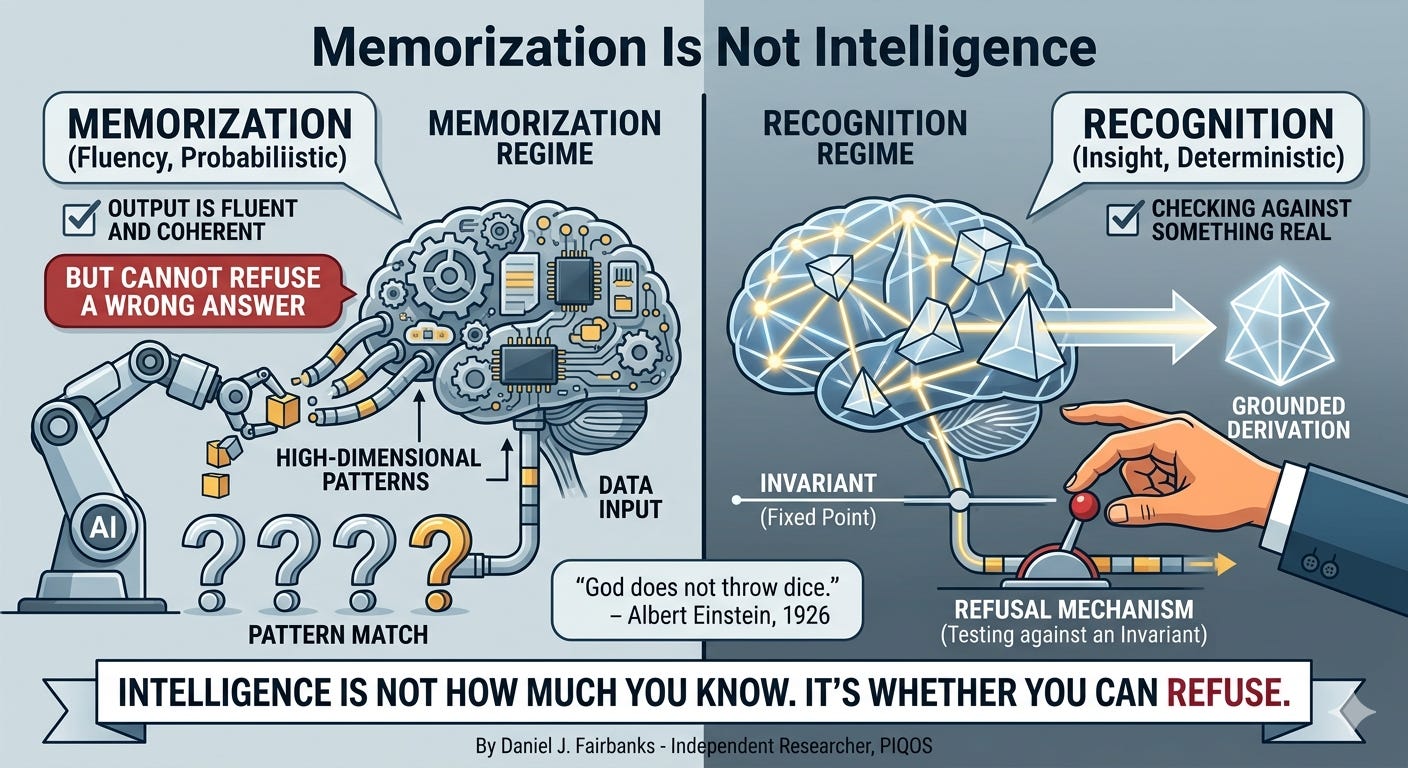
The mistake starts with assuming that memorization and recognition are degrees of the same thing, that if you memorize enough, you'll eventually understand. This is wrong in a way that has profound consequences.
Memorization is probabilistic and slop-tolerant. It works by storing high-dimensional patterns and retrieving the closest match. "Close enough" is acceptable. Partial matches are fine. The output is fluent, coherent-sounding, and often impressive, because it's drawing on a vast reservoir of prior human expression. But it has no internal mechanism for refusing a wrong answer. It can only produce what the pattern suggests.
Recognition is something fundamentally different. It operates by testing an input against an invariant a fixed point that doesn't move. Either the relationship holds, or it doesn't. There is no "close enough." Partial matches are rejected, not accepted with a shrug. This is why genuine mathematical insight feels different from fluent equation manipulation: one is checking against something real, the other is performing the appearance of checking.
Scaling memorization never produces recognition. You cannot get there from here by adding more of the same thing.
These are orthogonal regimes. Not points on a line. This means that making a memorization system larger, faster, or more heavily trained does not move it toward recognition. It just produces more fluent memorization. The current assumption driving both AI development and elite education, that more knowledge leads to more understanding, is built on a false premise.
The Einstein Dissection...
The clearest case study in the historical record is Einstein versus his contemporaries in the quantum mechanics debate of the early 20th century.
Einstein refused, his entire career, to accept the Copenhagen interpretation of quantum mechanics. "God does not play dice." He wasn't being conservative or sentimental. He was holding a specific standard.. a fundamental theory of physics must have a mechanism. Wavefunction collapse without derivation isn't an answer, it's a placeholder with good branding.
He paid an enormous cost for this position. By the 1940s and 50s, mainstream physics had moved on. His refusal to accept probabilistic foreground as final was read as the failure of an aging mind to adapt. He died isolated from the field he had transformed.
"The theory says a lot, but does not really bring us any closer to the secret of the Old One. I, at any rate, am convinced that He does not throw dice."
Albert Einstein, letter to Max Born, 1926
His quantum mechanics colleagues, Bohr, Heisenberg, the Copenhagen orthodoxy, were, by every conventional measure, brilliant. Heisenberg uncertainty was not wrong. The practical results were extraordinary: transistors, lasers, nuclear technology. But the core interpretive move "don't ask what it means, just calculate" was a deferral. It elevated a good-enough working model to the status of a fundamental answer. And it worked, socially and professionally, with remarkable efficiency. The people who accepted probabilistic foreground dominated the field, controlled the funding, shaped the curriculum.
IQ tests, administered to both camps, would have ranked the Copenhagen physicists higher. High verbal scores. Fast pattern retrieval. Fluent manipulation of complex formalism. Einstein's stubborn refusal to accept an incomplete answer, his insistence on a mechanism, looked, by those metrics, like a limitation.
Common sense, in Einstein's case, was not the absence of rigor. It was the rigor. The "God does not play dice" intuition was a living-body check, the feeling that a fundamental theory cannot bottom out in "it just does that." That felt wrongness is not mysticism. It is the refusal mechanism working correctly.
The Folk Riddle Factory.....
There is a specific pattern by which fluency-dominant cognition produces the appearance of original insight without actually generating it. Once you see it, you cannot unsee it.
It works like this: take a piece of folk wisdom already resident in the collective subconscious, a proverb, a cultural cliché, an obvious observation dressed in plain language. "You can't get something for nothing." "If you're not first, you're last." "Things fall apart." These resonate because they're true, and because they've been circulating for generations. The subconscious already accepts them.
Now perform unbounded expansion. Wrap the folk wisdom in formal mathematical language. Attach it to existing academic frameworks. Give it a name, ideally with an acronym. Submit to a venue where reviewers will recognize the resonant base and be impressed by the formal superstructure. The base riddle feels profound (because it's familiar). The mathematics feels rigorous (because it's technically correct). The combination bypasses the check that should ask: did this actually derive anything new?
Worked Example
Start with: "If you ain't first, you're last" (Ricky Bobby, Talladega Nights).
Expand to: The Positional Zero-Sum Exclusion Principle (PZSEP) in any ranked competitive system, the marginal utility of non-maximal position converges to zero as competitive intensity increases, consistent with No-Free-Lunch constraints on optimization landscapes.
The mathematics is not wrong. The principle is not false. But nothing was derived. A folk observation was dressed in formal language. This is publishable. This is, in many venues, rewarded.
The reason this works is that the evaluation machinery peer review, citation metrics, academic prestige, is itself predominantly fluency-based. It checks whether arguments are well-formed, whether citations are appropriate, whether the formalism is handled correctly. It is much less effective at asking whether anything new was actually generated from first principles. Detecting the difference requires holding a fixed point and checking derivation against it. Most reviewers don't have one.
What IQ Tests Are Actually Measuring
Meta-analytic data across large educated samples shows that verbal and crystallized intelligence subtests account for roughly 40–55% of variance in IQ scores. Fluid reasoning, the capacity to solve genuinely novel problems without prior pattern, explains only 25–35%. In elite academic cohorts, the verbal-performance IQ gap can reach 30–40 points.
This means our primary tool for identifying high intelligence is predominantly measuring fluency. The capacity to retrieve and manipulate stored patterns. The ability to produce well-formed verbal output quickly. These are real skills. They correlate with academic success, income, and professional achievement. But they are measuring the memorization regime, not the recognition regime.
There is no subtest that rewards refusal. No item that gives credit for saying "this question cannot be answered from the information provided and here is the precise reason why." No measure of the willingness to hold an uncomfortable non-answer rather than produce a fluent but groundless one. The tests are, structurally, selecting for the thing that produces impressive output, not for the thing that produces correct output.
True genius is never without common sense. Common sense is foreground deterministic rigor. Everything else is well-trained opportunism wearing a mask.
The result is that "brilliant but no common sense" is not a description of a rare cognitive trade-off. It is a description of who the selection process chose. We built institutions that reward verbal fluency and then acted surprised when the people who rise through those institutions are very good at producing fluent output and less reliable at producing grounded derivations.
AI as Mirror...
Current large language models are not an accident. They are the optimization target of the same selection pressure, executed at scale.
A language model is trained to predict the next token. This is, precisely, a memorization objective. The training process rewards the system for producing output that resembles what the training corpus would produce. It is extraordinarily good at this. The verbal fluency of modern AI systems is genuinely remarkable, they can produce well-formed, contextually appropriate, impressively structured text across almost any domain.
What they cannot do, structurally, not as a matter of current capability that future scaling will fix, is refuse. There is no internal invariant to check against. There is no mechanism that detects "this answer is fluent but wrong" in a way that stops the output. The system produces what the pattern suggests. If the pattern suggests a wrong answer with high confidence, the system produces it confidently. This is not a bug. It is the direct consequence of training for memorization.
The parallel to our IQ-selected cognitive elite is not coincidental. Both systems were optimized for the same thing: producing impressive output in verbal/formal domains. Both succeed brilliantly in that task. Both fail, in the same characteristic way, when the task requires deriving something that isn't already in the pattern, or refusing something that doesn't hold up under genuine scrutiny.
What Recognition Requires..
The shift from memorization to recognition is not a matter of degree. It requires something structurally different: a fixed point that doesn't move, and a willingness to refuse anything that doesn't hold against it.
In human cognition, this is what "common sense" actually means when it's functioning correctly. Not the subconscious background calculator that handles basic survival heuristics. The foreground capacity to hold a invariant, this doesn't add up, something is wrong here, I don't have a mechanism for this yet, and refuse to proceed until the check is satisfied. Einstein had this. The Copenhagen orthodoxy, for all their technical brilliance, had quietly set it aside in favor of a productive working model.
The cost of holding this standard is real. You produce less. You accept fewer invitations to build on incomplete foundations. You decline to offer confident answers to questions you cannot ground. In most professional contexts, this looks like a limitation. The person who says "I don't know, and here is exactly why I don't know" is evaluated as less capable than the person who says something confident and well-structured, even if the confident thing is wrong.
This is the selection pressure we have built. And it runs in both directions, into our institutions and into our machines.
The Path Out....
Three things need to change simultaneously, because they reinforce each other.
How we test intelligence. Verbal weighting in IQ assessments needs to come down significantly, from roughly half the variance to perhaps a fifth. Fluid reasoning, the capacity to solve genuinely novel problems, should carry more weight. Most importantly, tests should include items that reward refusal: problems where the correct answer is "insufficient information" or "this question contains a false premise." Currently, saying nothing scores zero. Saying something fluent scores partial credit. This incentive structure selects for exactly the wrong thing.
How we build AI. Next-token prediction as a training objective produces memorization systems. A system capable of recognition needs something different: an internal invariant that propositions are checked against, and a rejection mechanism that fires when the check fails. Not a filter applied after generation. An architectural property of how the system processes information. The difference is not a matter of scale. It is a matter of design.
How we educate. Rewarding fluency without mechanism, giving credit for well-structured answers that don't actually derive their conclusions, is selecting for the wrong cognitive profile. The student who says "I can reproduce the standard derivation but I don't understand where this assumption comes from" is demonstrating something more valuable than the student who produces the derivation flawlessly. We currently grade them the same or worse.
These are not independent interventions. The tests shape who enters elite positions. The education shapes cognitive development before the tests. The AI systems we build reflect and amplify the cognitive culture we've created. All three selecting for memorization produces a self-reinforcing loop. All three shifting toward recognition produces a different one.
The insight that memorization and recognition are orthogonal, not degrees of the same thing, is not just an academic observation. It determines whether you think the path to machine intelligence runs through scaling current systems further, or whether it requires something structurally different. It determines whether "brilliant but no common sense" is a tolerable trade-off or a diagnostic failure. It determines whether the person in the room who keeps saying "I don't have a mechanism for that" is the problem or the only reliable signal.
Einstein was right. Not because he was more technically capable than his contemporaries. Because he refused to stop asking for the mechanism. That refusal is not a personality quirk. It is the core of what intelligence, correctly understood, actually is.
We have built systems, human and machine, that cannot refuse. We called this progress.
Daniel J. Fairbanks - independent researcher building toward cognitive reasoning AI that escapes the paradigm of Deterministics/probabilistic boundaries - PIQOS -